
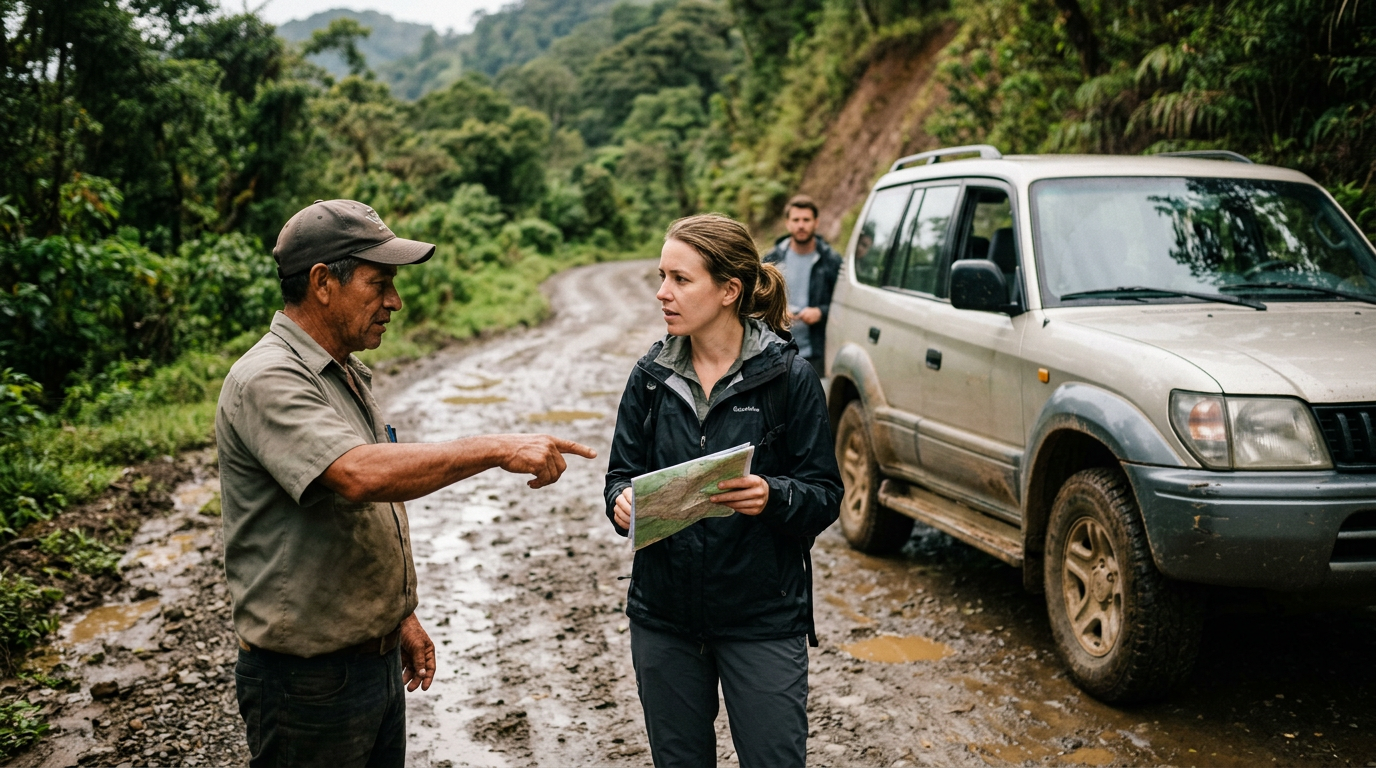
No, you do not always need a 4x4 in Costa Rica. If you are sticking to major paved roads, airport transfers, and towns like San José, La Fortuna, Manuel Antonio, or Tamarindo, a regular car is often enough. But for steep gravel roads, remote beaches, and rainy-season travel, a 4x4 can be the safer, cheaper choice overall.
A dusty SUV idles beside a steep gravel hill in Monteverde while a sedan slowly turns back downhill. A few hundred kilometers away, families in flip-flops roll past on a smooth highway near Manuel Antonio without a second thought.
So, do you need a 4x4 in Costa Rica? Sometimes yes, often no. The real answer depends less on the country and more on where you are going, what month you travel, and whether your hotel sits on a paved road.
The quick answer: when a 4x4 is worth it
If you are visiting Costa Rica for a classic first trip and staying in well-traveled tourist towns, a 4x4 is not automatically required. On the other hand, if your itinerary includes rural lodges, steep hills, muddy roads, or rainy-season beach towns, a 4x4 can save time, money, and stress.
Here is the practical rule we use when helping travelers book rentals in July 2026:
-
Usually no 4x4 needed: San José, Alajuela, Heredia, La Fortuna town, Manuel Antonio, Jacó, Tamarindo town, Playa Hermosa in many cases, Puerto Viejo town, Cahuita town.
-
Often smart to get a 4x4: Monteverde, Santa Teresa, Nosara side roads, Uvita hill properties, Osa Peninsula, remote Guanacaste beaches, some Sarapiquí lodges.
-
Strongly recommended in rainy season: May through November for any trip involving steep gravel, river crossings, or unpaved final-mile access.
A lot of travelers overbuy a 4x4 just because they saw one online. Others underbuy and then get stuck on a road their GPS made look harmless. The sweet spot is matching the vehicle to the actual route, not the marketing picture.
Myth vs. reality: the assumptions that cost travelers money
Myth 1: “Costa Rica is all bad roads, so I need a 4x4 everywhere”
Not true. The main highway network is paved and perfectly manageable in a normal car, especially for airport-to-hotel transfers and common tourist corridors. We drive these routes constantly, and the roads between major hubs are much better than many first-timers expect.
Myth 2: “A 4x4 means I can drive anywhere safely”
Also not true. A 4x4 helps with traction and clearance, but it does not fix bad judgment, washed-out roads, or river crossings after heavy rain. We’ve seen visitors in brand-new SUVs get stuck because they assumed the badge on the back was a magic pass.
Myth 3: “If my booking site says SUV, that means 4x4”
No. In Costa Rica, SUV and 4x4 are not the same thing, and plenty of travelers discover that the hard way at the rental counter. If your route needs traction, confirm the rental is true 4x4, not just a higher-riding automatic.
Myth 4: “A smaller car is always cheaper”
Sometimes the base rate is cheaper, but the real cost can flip after you factor in detours, extra transfer fees, and the possibility of having to park the car and take a shuttle for the last stretch. On a muddy access road, the cheapest car can become the most expensive choice.
Region-by-region breakdown: where 4x4 matters and where it doesn’t
Costa Rica is small enough that travelers assume one vehicle fits the whole country. That’s only partly true. Road quality changes fast once you leave the main corridors.
San José, airport areas, and Central Valley towns
If you are staying in San José, Alajuela, Escazú, Heredia, or Atenas and using the city as a base, a 4x4 is usually unnecessary. Main roads are paved, and the airport area is straightforward.
For business trips, quick city stays, or simple point-to-point driving, a normal car is fine. We would only push a 4x4 if you plan to head out to mountainous rural areas or combine the capital with remote nature lodges.
La Fortuna and Arenal
For most travelers, you do not need a 4x4 to reach La Fortuna town. The drive from San José is roughly 130 km / 81 miles and usually takes about 3 to 4 hours depending on traffic and route.
Where a 4x4 becomes useful is when your lodge sits on a steeper unpaved road, especially west or north of town. Some properties near the lake or deeper countryside can have rough final approaches, and rainy afternoons can turn that last kilometer into a headache.
If you want canyoning, waterfall hopping, or La Fortuna tours, the road into town itself rarely justifies paying for a 4x4. The hotel access road is the part to check carefully.
Monteverde and Santa Elena
This is one of the clearest regions where a 4x4 is often worth the money. The final approach to Monteverde from the main highway is slower, steep, and often rough enough to make budget sedans miserable. The drive from La Fortuna to Monteverde is around 110 km / 68 miles, but it can take 3.5 to 5 hours depending on road conditions and weather.
In dry season, some confident drivers manage with a regular car. In rainy season, we strongly prefer a 4x4 or at least a high-clearance vehicle booked with a company that clearly allows the route.
Manuel Antonio and Quepos
For the classic beach-and-wildlife trip, a 4x4 is usually not needed. The route from San José to Manuel Antonio is about 160 km / 99 miles and generally takes 3 to 3.5 hours on paved roads.
The one thing that changes the answer is your accommodation. If your hotel sits up a steep hill above Quepos or on a rough side road, you may want 4x4 traction for the final approach. If you’re staying in town or along the main access road, a regular sedan is usually fine.
If your plan includes Manuel Antonio tours, note that the park area itself does not require 4x4 driving. The private access road to your stay is the bigger issue.
Tamarindo, Nosara, and the Nicoya Peninsula
This is where the answer gets more seasonal. In dry season, a 2WD car can work for many routes into Tamarindo and some parts of the northern Nicoya Peninsula. But once rains start, road edges soften, potholes deepen, and the “last mile” to beach villas can become the problem.
Nosara is especially important. Many visitors can reach town without 4x4, but the final roads to some accommodations are another story. In July 2026, we still advise checking your lodge’s exact access road before booking a compact car.
A rough rule:
-
Tamarindo town: often fine without 4x4
-
Playa Grande / Playa Langosta: usually manageable, but check property access
-
Nosara and surrounding hills: 4x4 often smart, especially in rainy season
-
Remote beaches in Nicoya: 4x4 frequently recommended
Puerto Viejo, Cahuita, and the Caribbean side
For most east-coast travelers, a 4x4 is not essential. The roads into Puerto Viejo and Cahuita are generally manageable, and the main travel challenge is more about distance than terrain. The drive from San José to Puerto Viejo is around 220 km / 137 miles and usually takes 4.5 to 5.5 hours depending on traffic and stops.
That said, some beach lodges and jungle stays sit on unpaved side roads that can get slick after rain. If you plan to stay at a property far from town, ask about the final access road before booking. For town-based stays and Puerto Viejo tours, a regular car is often enough.
Osa Peninsula, Drake Bay access roads, and remote southern routes
This is one of the strongest 4x4 zones in the country. The Osa Peninsula combines long distances, changing road surfaces, and weather that can turn ordinary dirt into deep mud fast. If your itinerary includes road access toward Drake Bay, Playa Sierpe, or remote jungle lodges, a 4x4 is often the safer call.
Even then, some parts of the region are better served by boat or domestic flight. If you are heading deep into the Osa Peninsula, a 4x4 may help, but it is not always the only answer.
Guanacaste backroads, Rincon de la Vieja, and rural volcano zones
Beach towns on the main Guanacaste corridor are one thing. Rural volcano roads are another. Around Rincon de la Vieja, many hotels and adventure sites are on gravel or steep access roads where a 4x4 makes life easier.
If your trip is focused on hot springs, waterfall hikes, or ranch-style lodges, pay attention to the exact final stretch. A property may be only 20 km / 12 miles from the highway and still feel remote because the last 8 km / 5 miles are rough.
When you can save money with a regular car
A regular car is often the right move if your trip is built around paved routes and you want to keep the budget under control. In July 2026, we still see travelers overspend on 4x4s when a standard compact or small SUV would have worked fine.
Good candidates for a normal car:
-
Airport arrival, one-night city stop, then transfer out
-
Paved routes between San José, La Fortuna, Manuel Antonio, and Tamarindo town
-
Hotel stays with confirmed paved access
-
Travel in dry season with no planned off-road segments
Plan My Costa Rica’s car-rental recommendations are coming soon. Until then, book directly with a provider you trust and confirm the final price, insurance, and vehicle details before paying.
What you usually save by skipping 4x4:
-
Lower daily rental rate, often by $10–$35 per day
-
Lower deposit pressure at some agencies
-
Better fuel economy on long drives
-
Less stress about taking a vehicle onto roads it was never meant for
The key is honesty. If your lodge says “4x4 recommended,” assume that is not a sales gimmick unless you verify the exact road conditions with the property.
Local tip: ask the hotel, not just the rental desk, whether the last 2–5 km to the property are paved. That one question saves more headaches than any comparison chart.
What 4x4 actually costs in July 2026
Prices shift by season, company, insurance, and vehicle size, but these are the ranges we see most often right now:
-
Compact 2WD car: about $35–$70 per day
-
Small SUV / high-clearance 2WD: about $55–$95 per day
-
True 4x4 SUV: about $75–$140+ per day
-
Busy holiday periods: rates can jump 20–40% above normal
Remember that the headline rate is not the whole bill. In Costa Rica, travelers should also budget for insurance, taxes, deposits, and sometimes an extra driver fee. A deal that looks cheap online can become much more expensive once the required coverage is added.
Typical extra costs to ask about:
-
Mandatory insurance or coverage package
-
Deposit hold on your credit card
-
Child seat fee
-
Airport pickup surcharge
-
Additional driver fee
If you are comparing a 2WD to a 4x4, do the math on the full rental, not just the daily rate. Sometimes the price difference is modest. Other times it is enough to pay for a guided day tour or a nicer hotel.
How to decide in 60 seconds
If you want the short version, use this checklist before booking:
-
Look at your exact hotel location on the map.
-
Check whether the final road is paved or gravel.
-
Ask if there are river crossings, steep hills, or muddy sections.
-
Consider the month of travel. May to November makes rough roads more demanding.
-
Compare the rental cost of a 2WD versus 4x4 against the total trip budget.
If your trip is mostly San José, La Fortuna, Manuel Antonio, and the better-known beach towns, you probably do not need 4x4. If your trip includes Monteverde, Nosara backroads, Osa, or rural Guanacaste, the answer changes fast.
Best vehicle match by trip style
-
First-time classic loop: compact or small SUV
-
Beach-and-wildlife trip with paved hotels: compact SUV or sedan
-
Adventure trip with remote lodges: true 4x4
-
Rainy-season road trip: 4x4 or flexible itinerary with transfers
Booking strategy that avoids mistakes
The biggest rental mistake is not choosing the wrong vehicle model. It is choosing the wrong vehicle for the wrong route.
Do this instead:
-
Book the car only after your hotels are set.
-
Share your itinerary with the rental company.
-
Confirm whether a true 4x4 is needed, not just an SUV.
-
Avoid over-optimizing for the lowest daily rate.
-
Keep one backup plan, especially for rainy-season mountain or beach roads.
Plan My Costa Rica’s car-rental recommendations are coming soon. Until then, book directly with a provider you trust and confirm the final price, insurance, and vehicle details before paying.
Bottom line by region
Here is the plain-English version travelers actually need:
-
San José / Central Valley: no 4x4 needed
-
La Fortuna town: usually no, but check your lodge road
-
Manuel Antonio / Quepos: usually no
-
Tamarindo town: usually no
-
Monteverde: often yes
-
Nosara / remote Nicoya: often yes in rainy season
-
Puerto Viejo / Cahuita: usually no, unless your hotel is off-road
-
Osa Peninsula: often yes
-
Rural Rincon de la Vieja: often yes
So, do you need a 4x4 in Costa Rica? Not for every trip. But if your route includes rough final access, steep hills, or rainy-season dirt roads, the right 4x4 can be worth every dollar.
Plan My Costa Rica’s car-rental recommendations are coming soon. Until then, book directly with a provider you trust and confirm the final price, insurance, and vehicle details before paying.
Let's build your Costa Rica trip.
Browse locally-vetted tours, or tell us what you're dreaming up and we'll help shape it.
Common questions
Do you need a 4x4 in Costa Rica for the whole trip?+
Usually no. Many travelers can complete a standard itinerary on paved roads with a regular car, especially if they stay in San José, La Fortuna town, Manuel Antonio, or Tamarindo town.
Is an SUV the same as a 4x4 in Costa Rica?+
No. An SUV may have higher clearance, but that does not always mean four-wheel drive. If you need traction on steep or muddy roads, confirm that the rental is a true 4x4.
Do you need a 4x4 in Costa Rica during rainy season?+
More often, yes. From May through November, roads that are manageable in dry weather can become slick, rutted, or slow, especially in Monteverde, Nicoya, Osa, and rural Guanacaste.
Can you drive to Monteverde without a 4x4?+
Sometimes in dry season, yes, but it is not the comfortable default. For most travelers, a 4x4 is the safer and less stressful option for Monteverde.
Do you need a 4x4 to get to Manuel Antonio?+
Usually no. The main route is paved, and most visitors do fine with a regular car. Only properties on steep side roads may make a 4x4 helpful.
Is a 4x4 worth the extra cost in Costa Rica?+
If your itinerary is paved and simple, maybe not. If your hotel has rough access or you are driving in rainy season on rural roads, the extra cost is often worth it.
What is the cheapest safe vehicle for Costa Rica?+
For many routes, a compact or small SUV is the most budget-friendly safe choice. If your route includes remote roads, stepping up to a true 4x4 is better than trying to save a few dollars.